by zorins
Share
by zorins
Share

In today’s hyper-connected Saudi Arabian economy, the term الأمن السيبراني (cybersecurity) is more than an IT department issue; it is a critical pillar for enterprise survival, growth, and trust. Yet, many business leaders are overwhelmed by a sea of technical acronyms and face the constant pressure of meeting stringent compliance mandates from the National Cybersecurity Authority (NCA). The fear of catastrophic business disruption and the immense financial loss from a sophisticated cyber attack is a pressing reality for organizations across the Kingdom, making it difficult to justify necessary security investments to stakeholders.
This comprehensive guide is engineered to provide clarity and empower your decision-making. We will demystify the core principles of a robust cybersecurity strategy, identify the specific digital threats targeting Saudi businesses today, and outline actionable steps to build an impregnable defense. You will leave with a clear, high-level understanding of your risks and a strategic roadmap to protect your valuable assets, ensure full regulatory compliance, and confidently secure your enterprise’s future.
The Core Pillars of Modern Cybersecurity
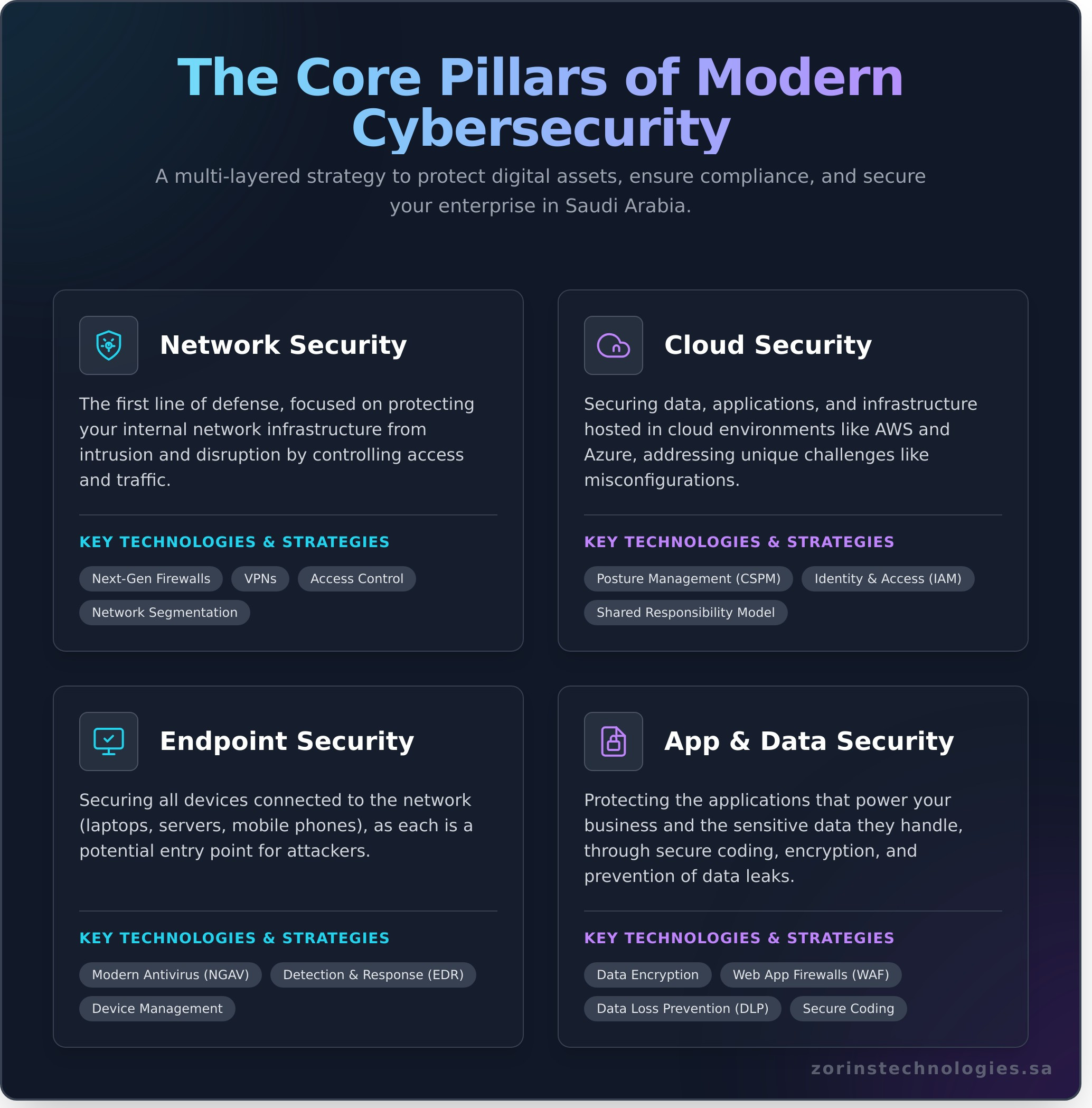
In today’s digital economy, understanding الأمن السيبراني (cybersecurity) is non-negotiable for any Saudi enterprise. At its core, cybersecurity is the practice of protecting digital assets—including networks, devices, applications, and data—from unauthorized access, attack, or damage. It is not a single product you can purchase, but rather a comprehensive, multi-layered strategy designed for robust defense. This strategy is built upon several core pillars of cybersecurity, most notably the CIA Triad: Confidentiality (ensuring data is accessible only to authorized users), Integrity (maintaining the accuracy and consistency of data), and Availability (ensuring systems and data are accessible when needed). A strong defense protects your critical data, safeguards your corporate reputation, and ensures operational continuity.
To better understand these foundational concepts, watch this helpful overview:
Network Security
This is the first line of defense, focused on protecting your internal network infrastructure from intrusion and disruption. It involves deploying and managing key technologies like next-generation firewalls from industry leaders like Fortinet, Virtual Private Networks (VPNs) for secure remote access, and stringent access control policies. A critical strategy here is network segmentation, which isolates different parts of your network to contain a potential breach and limit its impact across the enterprise.
Cloud Security
As businesses in the Kingdom of Saudi Arabia increasingly adopt cloud-first strategies, securing data and applications hosted in environments like AWS and Microsoft Azure is paramount. Cloud security addresses unique challenges, including common misconfigurations that can expose data and navigating the shared responsibility model between the cloud provider and the customer. A proper cloud security posture ensures your digital transformation is both innovative and secure, aligning with KSA’s Vision 2030 goals.
Endpoint Security
Every device connected to your network—from laptops and servers to mobile phones—is an endpoint and a potential entry point for attackers. Endpoint security focuses on securing these devices through advanced solutions like modern antivirus software and Endpoint Detection and Response (EDR) platforms. These tools provide real-time monitoring and threat response capabilities, creating an impregnable defense at the most vulnerable points of your organization.
Application & Data Security
Ultimately, the goal of any robust الأمن السيبراني strategy is to protect the applications that power your business and the sensitive data they handle. This pillar involves integrating security into the entire application lifecycle through secure coding practices, vulnerability scanning, and Web Application Firewalls (WAF). Furthermore, it employs techniques like strong encryption for data at rest and in transit, alongside Data Loss Prevention (DLP) solutions to prevent unauthorized exfiltration of customer and company data.
Why Cybersecurity is a Business Imperative in Saudi Arabia
In the rapidly advancing economy of Saudi Arabia, cybersecurity is no longer an IT department concern; it is a fundamental business imperative. As the Kingdom undergoes a monumental digital transformation driven by Vision 2030, the attack surface for businesses has expanded exponentially. High-profile cyber attacks across the region serve as a stark reminder that vulnerability can lead to catastrophic financial and reputational damage. For Saudi enterprises, establishing a robust الأمن السيبراني posture is now a critical component of sustainable growth, customer trust, and national economic resilience.
Aligning with Saudi Vision 2030
Digitalization is the engine of Vision 2030, making advanced cybersecurity a foundational requirement for its success. The development of smart cities like NEOM, the execution of giga-projects, and the rollout of seamless digital government services all depend on a secure and trusted digital infrastructure. A fortified digital environment not only protects these national assets but also attracts the foreign investment and global partnerships essential for economic diversification. Strong security is a competitive advantage that signals reliability and readiness for the future.
Navigating the Regulatory Landscape: The NCA
The Kingdom has established a clear governance structure to manage cyber risks, led by the National Cybersecurity Authority (NCA). The NCA is responsible for developing and enforcing cybersecurity policies and standards across the nation. A key component of this is the Essential Cybersecurity Controls (ECC) framework, a mandatory set of requirements for government and critical infrastructure organizations. The ECC provides a comprehensive baseline, similar in principle to established international guidelines like the U.S. FCC’s Cybersecurity defense framework, but specifically tailored to the Saudi landscape. Compliance is non-negotiable, and failure to meet these standards can result in significant penalties and legal liabilities.
Unsure about NCA compliance? Our experts can guide you.
Protecting Critical National Infrastructure
The security of individual enterprises is directly linked to the security of the nation. Sectors such as energy, finance, telecommunications, and healthcare are prime targets for sophisticated threat actors. A successful attack on one part of the supply chain can create a domino effect, impacting major national industries and essential services. Therefore, private sector businesses are on the front lines of defending the Kingdom’s critical infrastructure. A proactive approach to الأمن السيبراني is not just good business practice—it is a contribution to national security.
Top Cyber Threats Facing Businesses in the Kingdom
While understanding the concept of cybersecurity is foundational, recognizing the tangible threats targeting Saudi enterprises is critical for survival and growth. Threat actors are sophisticated and relentless, targeting businesses of all sizes—from emerging startups in Riyadh and e-commerce stores like Crystalax to established industrial firms in Jeddah. A proactive defense requires a clear understanding of the most prevalent risks to your organization’s digital infrastructure and the national vision for الأمن السيبراني (cybersecurity).
Phishing and Social Engineering
This is the art of digital deception. Attackers manipulate your employees through fraudulent emails, messages, or calls to trick them into revealing sensitive information like passwords or financial data. A common tactic is spear-phishing, where a highly personalized email is sent to a specific executive, appearing to be from a trusted partner and requesting an urgent transfer of funds. Your first and most critical line of defense is not technology, but a well-trained, vigilant workforce.
Ransomware
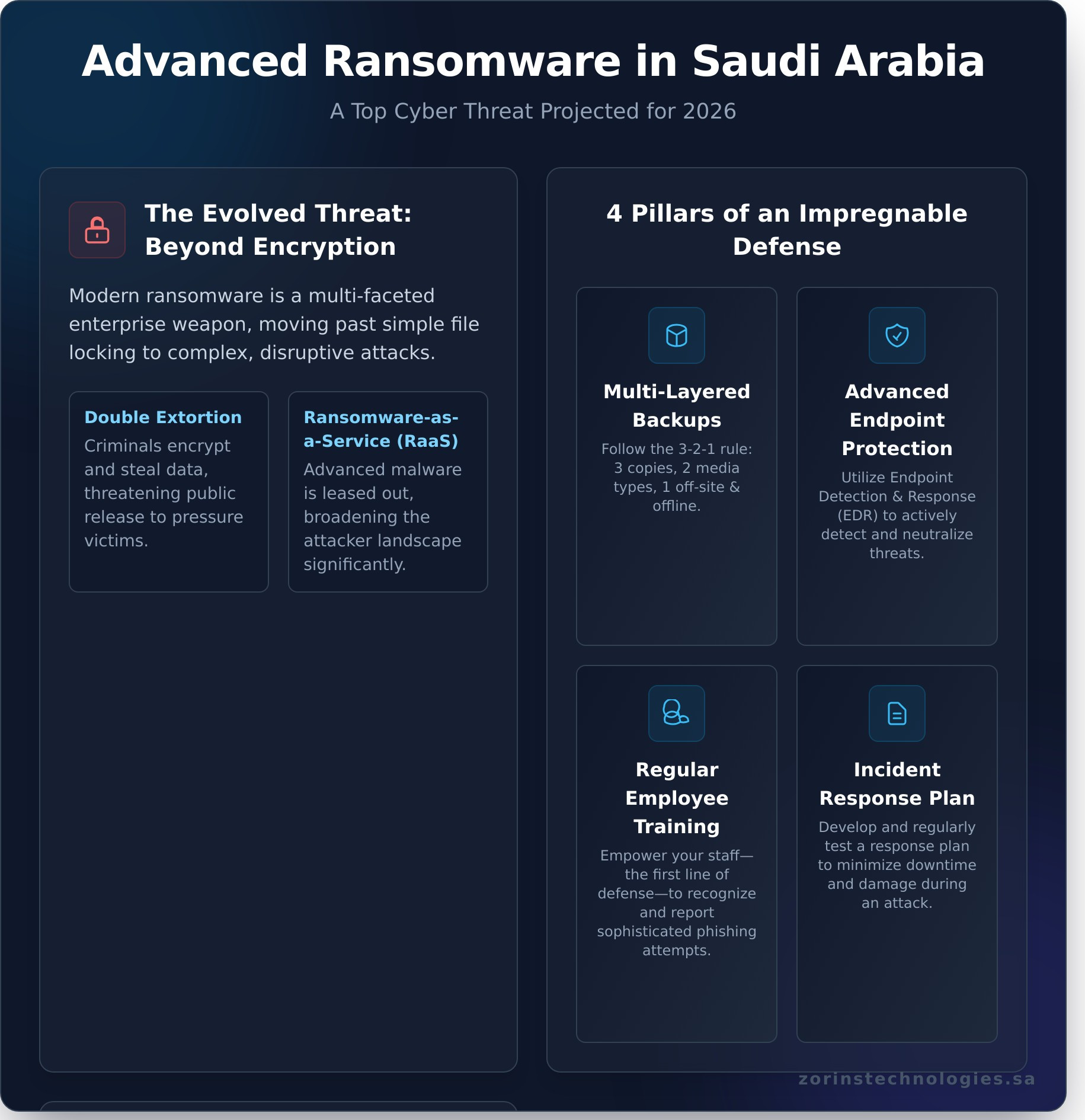
Ransomware is a direct assault on business continuity. In this attack, malicious software encrypts your critical files—from financial records to customer databases—making them completely inaccessible. The attackers then demand a hefty ransom, often thousands of Saudi Riyals, for the decryption key. The cost is not just financial; a successful attack leads to catastrophic downtime, loss of customer trust, and severe reputational damage. An impregnable defense against ransomware is built on robust, regularly tested data backups and a strategic incident response plan.
Insider Threats
Often the most challenging threats to detect are those that originate from within your network. These can be either malicious, from a disgruntled employee intentionally stealing data, or negligent, from an employee accidentally exposing sensitive information. Because these individuals already have legitimate access, they can bypass traditional perimeter defenses. Mitigating this risk requires a zero-trust approach, implementing granular access controls and continuous activity monitoring. This internal challenge is a key focus for Saudi Arabia’s National Cybersecurity Authority (NCA), which provides frameworks to help organizations fortify their defenses against all threat vectors.
Building Your Cybersecurity Defense: A 4-Step Framework
Effective cybersecurity is not a product you buy; it is a continuous, strategic business function. For Saudi businesses navigating an evolving threat landscape, this 4-step framework provides a clear lifecycle for building a resilient defense. It ensures your investments in الأمن السيبراني are targeted and effective, transforming security from a reactive cost center into a proactive driver of business continuity and trust.
Step 1: Identify & Assess
The foundation of any impregnable defense is a deep understanding of your unique vulnerabilities. This initial phase involves comprehensive risk assessments to pinpoint your weakest links, cataloging all critical data and hardware assets. We meticulously analyze your environment to identify specific security gaps and ensure alignment with key Saudi regulations, such as the National Cybersecurity Authority (NCA) Essential Cybersecurity Controls (ECC).
Step 2: Protect
With a clear map of your risks, we implement a multi-layered, proactive defense. This involves deploying advanced protective controls, including next-generation firewalls, secure access management, and endpoint protection from industry-leading partners like Cisco and Palo Alto Networks. We also assist in developing robust security policies and delivering critical employee training to fortify your human firewall—often the first line of defense.
Step 3: Detect
You cannot stop a threat you cannot see. Proactive, 24/7 detection is non-negotiable. Our Security Operations Center (SOC) leverages cutting-edge Security Information and Event Management (SIEM) platforms, such as LogRhythm, for real-time monitoring of your network. Our expert teams actively hunt for hidden threats and anomalous activity, ensuring any potential breach is identified in minutes, not months.
Step 4: Respond & Recover
When an incident occurs, a swift, coordinated response is vital to minimizing damage. We help you develop and test a detailed Incident Response Plan before an attack happens. This plan outlines clear, actionable steps to contain the threat, eradicate it from your systems, and restore operations efficiently. A robust business continuity and disaster recovery strategy is integral to this phase, safeguarding your operations and revenue.
This complete lifecycle—from identification to recovery—forms the core of a modern strategy for الأمن السيبراني. As your trusted partner, Zorins Technologies possesses the expertise and advanced solutions to manage this entire framework, securing your enterprise for sustainable growth. Contact our professionals for a strategic consultation today.
How to Choose the Right Cybersecurity Partner in Saudi Arabia
Understanding cyber threats and defensive strategies is a critical first step. However, the most decisive factor in your security posture is selecting the right partner to implement, manage, and evolve your defenses. For businesses in the Kingdom, choosing a partner is a strategic decision that directly impacts operational resilience and compliance. When evaluating potential vendors, focus on three non-negotiable criteria.
Look for Proven Technical Expertise
A credible partner’s capabilities must be backed by verifiable credentials and a history of success. Do not rely on promises; demand proof. An elite partner will readily provide:
- Industry Certifications: Look for official partnerships and advanced certifications with global technology leaders like Cisco, Fortinet, and HPE. This demonstrates a deep, tested knowledge of enterprise-grade security architecture.
- Local Case Studies: Ask for references and case studies from other Saudi businesses. This confirms their ability to deliver tangible results within your market.
- Threat Intelligence: Ensure they have a dedicated focus on the latest threat vectors targeting the region, not just generic global trends.
Prioritize Local Presence and Understanding
Global expertise is valuable, but local presence is essential. A partner with a physical office in Riyadh or Jeddah offers significant advantages. They possess an intrinsic understanding of the local business culture and, most importantly, the Kingdom’s regulatory landscape. Expertise in the National Cybersecurity Authority (NCA) frameworks is not optional—it is a fundamental requirement for compliance and operational continuity. Furthermore, in the event of a critical security incident, the ability to deploy on-site engineers is invaluable.
Evaluate their Portfolio of Solutions
Effective الأمن السيبراني is not a single product but an integrated, end-to-end strategy. Avoid vendors who only push one type of solution. A truly strategic partner offers a comprehensive portfolio that covers the entire security lifecycle, from initial assessment and strategic consulting to the implementation of cutting-edge hardware and ongoing managed services for 24/7 monitoring. This ensures you have a single, accountable partner for your entire security posture. Schedule a consultation with our certified security experts today.
Fortify Your Business with a Proactive Cybersecurity Strategy
In today’s rapidly evolving digital landscape, a robust cybersecurity framework is a fundamental pillar of business continuity and growth in Saudi Arabia. As we’ve explored, the threats are sophisticated and persistent, but a proactive, structured defense is your most powerful asset. Mastering الأمن السيبراني is essential for protecting your critical data, maintaining customer trust, and ensuring full compliance with national standards.
Navigating this complex environment requires a partner with proven, enterprise-grade expertise. Zorins Technologies is uniquely positioned to be that partner. As a premier partner with global leaders like Cisco, Fortinet, and HPE, we implement cutting-edge security solutions. Our deep expertise in the Saudi Arabian regulatory environment, including the National Cybersecurity Authority (NCA) framework, combined with our local presence in Riyadh, ensures you receive expert, on-site support tailored to your specific operational needs.
Don’t leave your digital assets vulnerable. Secure your business with a strategic cybersecurity consultation from Zorins Technologies.
Take the definitive step towards building an impregnable defense for your enterprise today.
Frequently Asked Questions About Cybersecurity in Saudi Arabia
What is the first step my company should take to improve its cybersecurity?
The foundational first step is a comprehensive cybersecurity risk assessment. This expert-led audit evaluates your existing infrastructure, policies, and potential vulnerabilities across your network and endpoints. It provides a clear, data-driven analysis of your security posture, identifying critical weaknesses before they can be exploited. This assessment forms the basis for a strategic, prioritized roadmap to build an impregnable defense tailored to your specific business operations and risk profile.
How much does cybersecurity cost for a small or medium-sized business in KSA?
The investment in cybersecurity varies based on company size, industry, and the complexity of your digital assets. For an SME in Saudi Arabia, a foundational package including managed firewalls, endpoint protection, and essential monitoring can range from SAR 20,000 to SAR 75,000 annually. More comprehensive solutions incorporating advanced threat detection and 24/7 security operations center (SOC) services will require a more significant, customized investment to ensure optimal business continuity.
Are small businesses really a target for sophisticated cyber attacks?
Yes, unequivocally. Threat actors view SMEs as high-value targets precisely because they often lack the enterprise-grade security infrastructure of larger corporations. Cybercriminals exploit this perception, using smaller businesses as gateways to attack larger partners in their supply chain or for direct financial gain. The threat is not a matter of size but of opportunity; therefore, a robust security posture is not optional, it is a mission-critical requirement for survival and growth.
What is the difference between a firewall and an antivirus?
These are two distinct but essential layers of security. A firewall, such as those from industry leaders like Fortinet or Cisco, acts as a perimeter gatekeeper for your network. It inspects and filters all incoming and outgoing traffic, blocking unauthorized access. In contrast, an antivirus or endpoint protection solution is installed directly on devices (computers, servers) to detect, quarantine, and eliminate malicious software that has managed to bypass the perimeter defenses.
How can employee training reduce our company’s cyber risk?
Human error remains a primary vector for cyber attacks. Professional employee training transforms your staff from a potential vulnerability into your first line of defense. It equips them to recognize and report sophisticated threats like phishing, social engineering, and ransomware attempts. By instilling a security-conscious culture, you significantly reduce the risk of a breach, thereby strengthening your organization’s overall الأمن السيبراني (cybersecurity) and protecting your critical assets from the inside out.
What is the role of the National Cybersecurity Authority (NCA) and do I need to comply?
The National Cybersecurity Authority (NCA) is the Kingdom of Saudi Arabia’s governing body responsible for establishing and enforcing national cybersecurity policies and standards. Compliance with its frameworks, such as the Essential Cybersecurity Controls (ECC), is mandatory for government entities and critical national infrastructure operators. For other private businesses, aligning with NCA guidelines is a strategic best practice that demonstrates a commitment to security, builds trust, and is often required for contracts with major enterprises.
STAY IN THE LOOP
Subscribe to our free newsletter.
Leave A Comment

Navigating the path to a successful career in cybersecurity within Saudi Arabia can feel overwhelming. With a rapidly evolving digital landscape...

For business leaders across the Kingdom of Saudi Arabia, the strategic shift to cloud infrastructure is no longer a question of if, but how. Yet,...

As Saudi Arabia's digital transformation accelerates towards Vision 2030, the landscape for cyber security in Saudi Arabia has become increasingly...