by zorins
Share
by zorins
Share

As Saudi Arabia’s digital transformation accelerates towards Vision 2030, the landscape for cyber security in Saudi Arabia has become increasingly complex and high-stakes. For enterprise leaders, navigating this new terrain is a critical challenge where a single oversight can lead to catastrophic operational disruption, significant financial loss, and non-compliance with essential regulations from authorities like the National Cybersecurity Authority (NCA). The sheer volume of potential threats can feel overwhelming, leaving businesses unsure of where to focus their defense efforts for maximum impact.
This is why we have cut through the noise. This article provides a clear, strategic overview of the top five cyber threats projected to impact the Kingdom in 2026. We move beyond complex jargon to deliver actionable intelligence and robust defense strategies your organization can implement to build an impregnable security posture. By understanding these specific risks, you can ensure business continuity, protect your valuable data, and confidently secure your digital future in the Saudi market.
The Evolving Threat Landscape: Cybersecurity in the Era of Vision 2030
Saudi Arabia’s Vision 2030 is the catalyst for one of the world’s most ambitious digital transformations. While this rapid innovation unlocks unprecedented economic opportunities, it simultaneously and exponentially expands the digital attack surface for every enterprise in the Kingdom. The proliferation of IoT devices in smart cities, widespread cloud adoption, and the development of giga-projects create new, complex entry points that threat actors are eager to exploit.
To better understand the current strategic discussions, this recent expert panel provides valuable insights into the national cybersecurity landscape.
In this high-stakes environment, the nature of cyber threats has fundamentally evolved. Generic, widespread attacks are being replaced by highly sophisticated, targeted campaigns aimed specifically at Saudi entities. Consequently, advanced cyber security saudi arabia is no longer a reactive IT cost but a foundational pillar for sustainable growth, business continuity, and national economic security. It is a critical enabler of the very innovation that Vision 2030 champions.
Why Saudi Businesses are a Prime Target
The Kingdom’s significant economic power and its critical role in global energy markets make its infrastructure a high-value target for state-sponsored actors and cybercriminals. As businesses digitize, they accumulate vast reserves of sensitive data—from financial records and customer information to intellectual property and operational technology (OT) schematics. Geopolitical factors further amplify this risk, turning Saudi enterprises into pawns in larger digital conflicts. Adversaries are motivated by financial gain, industrial espionage, and disruption.
Understanding Your Responsibility: NCA Compliance
To fortify the nation’s digital domain, the National Cybersecurity Authority (NCA) has established a robust governance framework. The NCA’s Essential Cybersecurity Controls (ECC) provide a clear, actionable roadmap for organizations to build a resilient security posture. Adherence to these standards is not merely a legal requirement; it is the strategic baseline for defending against modern threats. Embracing this framework allows businesses to manage risk proactively and build an impregnable defense that fosters trust and ensures long-term success.
Threat 1: Advanced Ransomware Targeting Critical Infrastructure and Enterprises
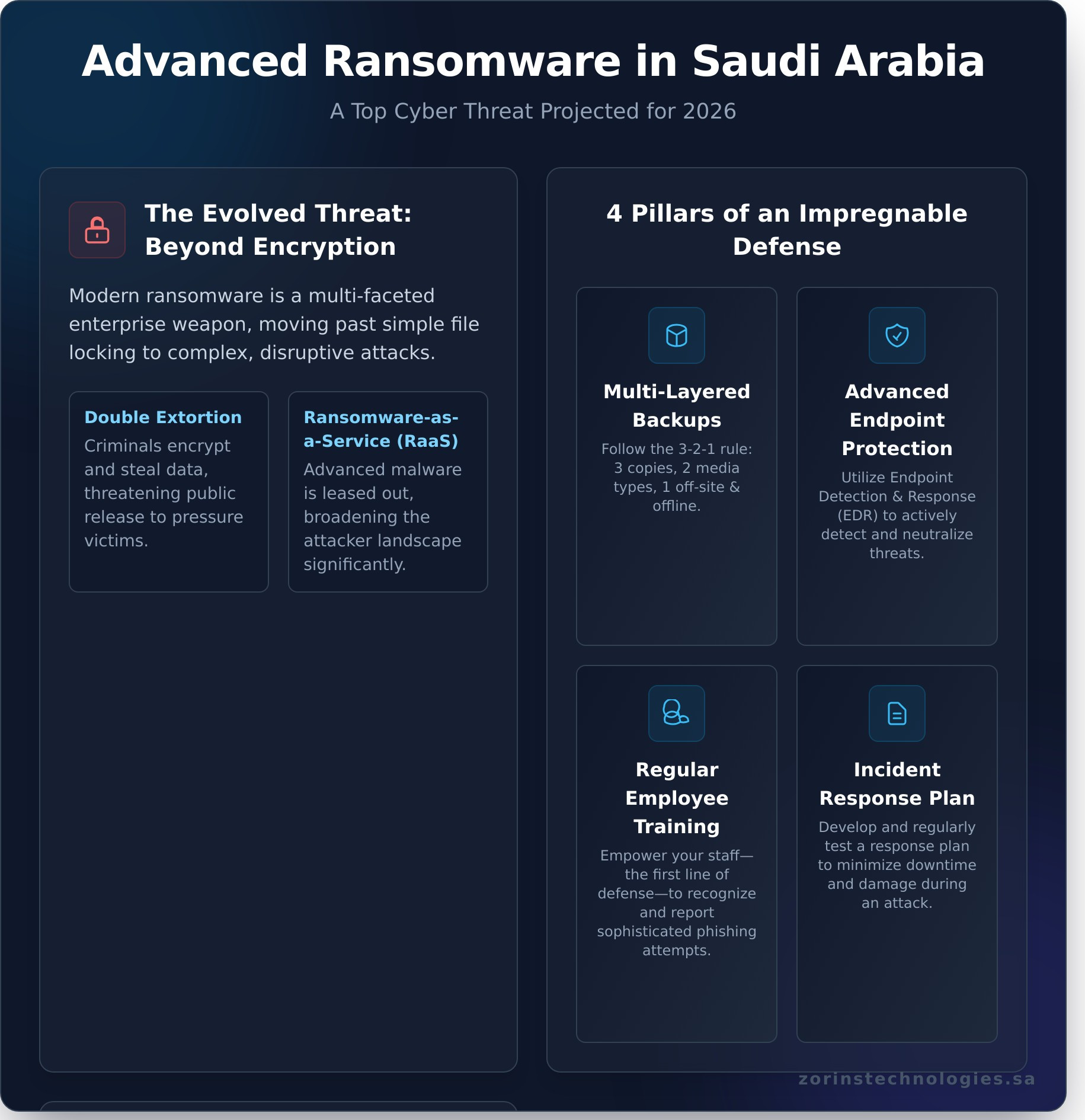
In 2026, ransomware is no longer a simple file encryption threat; it is a sophisticated, multi-faceted enterprise weapon. Modern ransomware attacks now incorporate double extortion tactics, where cybercriminals not only encrypt critical data but also exfiltrate it, threatening public release if the ransom is not paid. This evolution is powered by the Ransomware-as-a-Service (RaaS) model, which allows less-skilled attackers to lease advanced malware, broadening the threat landscape significantly. A successful attack inflicts severe financial damage, with recovery costs often reaching millions of Saudi Riyals, and causes irreparable harm to an organization’s reputation. Crucially, paying the ransom offers no guarantee of data recovery or that the stolen information will not be sold or leaked.
Local Impact: Why Ransomware Thrives in KSA
The Kingdom’s rapid economic diversification under Vision 2030 has accelerated the digitization of critical sectors, including energy, finance, and logistics. While this drives innovation, it also creates a larger attack surface for threat actors. An attack on a single entity in these interconnected industries can trigger a cascade failure, disrupting national supply chains and essential services. The government’s focus on securing this new digital frontier, as outlined in the National Cybersecurity Strategy, highlights the scale of the risk. This makes robust cyber security Saudi Arabia‘s top priority for national and economic stability.
Defensive Strategies Against Ransomware
Building an impregnable defense against advanced ransomware requires a proactive, multi-layered strategy. Enterprises must move beyond basic prevention to ensure comprehensive business continuity. At Zorins Technologies, we recommend a robust framework built on these core pillars:
- Implement Multi-Layered Backups: Adhere to the 3-2-1 rule—three copies of your data, on two different media types, with one copy stored off-site and offline (air-gapped). This ensures a clean recovery point is always available.
- Deploy Advanced Endpoint Protection: Utilize cutting-edge Endpoint Detection and Response (EDR) solutions from industry leaders like Cisco and Fortinet to actively monitor, detect, and neutralize threats before they can execute and spread across your network.
- Conduct Regular Employee Training: Your staff is the first line of defense. Continuous security awareness training is essential to help them recognize and report sophisticated phishing attempts, the primary delivery vector for ransomware.
- Develop and Test an Incident Response Plan: A pre-defined and well-rehearsed incident response plan is critical for minimizing downtime and damage. Regular testing ensures your team can respond swiftly and effectively to contain an attack and initiate recovery protocols.
Threat 2: Sophisticated Phishing and Business Email Compromise (BEC)
While generic phishing emails with obvious errors are becoming easier to spot, threat actors have evolved their tactics. Today, Saudi Arabian enterprises face a far greater risk from highly targeted spear-phishing and its devastating financial consequence: Business Email Compromise (BEC). Unlike broad phishing campaigns, BEC attacks are meticulously researched, using social engineering to impersonate senior executives or trusted vendors. The objective is not just to steal credentials but to manipulate employees into authorizing fraudulent wire transfers or releasing sensitive data, exploiting human trust as the primary vulnerability.
A common BEC scenario involves an attacker, posing as the CEO, emailing the finance department with an urgent, confidential request to process an invoice for a new acquisition, demanding immediate payment in the millions of Saudi Riyals. By stressing urgency and authority, they bypass standard verification protocols, leading to direct financial loss.
The Cultural and Business Context in Saudi Arabia
Attackers are astutely localizing their campaigns to exploit the Kingdom’s unique business environment. They leverage an inherent respect for hierarchy, knowing that a request from a high-level executive is less likely to be questioned. These attacks often use flawless Arabic and reference culturally significant events or major national initiatives like Vision 2030 projects to appear legitimate. This growing threat vector is a key reason why Saudi Arabia’s National Cybersecurity Strategy emphasizes human awareness. The risk escalates during high-pressure periods such as Ramadan or year-end financial closing, when teams are focused on deadlines and more susceptible to manipulation.
Building a Human Firewall
Technology alone cannot stop attacks that target human psychology. A robust strategy for cyber security saudi arabia requires building a resilient “human firewall.” Zorins Technologies recommends an integrated defense combining advanced technology and rigorous training:
- Implement Multi-Factor Authentication (MFA): Enforce MFA across all critical systems, especially email and financial applications, to create an essential barrier against compromised credentials.
- Establish Strict Verification Processes: Mandate out-of-band confirmation (e.g., a direct phone call to a known number) for any financial transfer requests or changes to vendor payment details, regardless of apparent urgency.
- Deploy Advanced Email Security: Utilize cutting-edge email security gateways from industry leaders like Fortinet and Cisco, which employ anti-spoofing technologies (DMARC, DKIM, SPF) to detect and block fraudulent impersonations before they reach the inbox.
- Conduct Regular Phishing Simulations: Move beyond annual training with realistic, continuous phishing simulation campaigns. These exercises train staff to identify and report sophisticated threats, turning a potential vulnerability into a proactive line of defense.
Threat 3: Supply Chain Attacks and Third-Party Vulnerabilities
A supply chain attack is a sophisticated threat where adversaries infiltrate your organization by compromising a less secure, trusted third-party vendor. This indirect approach exploits the interconnected nature of modern business, affirming a critical principle of enterprise security: your defenses are only as strong as your weakest partner. Imagine a gourmet chef who meticulously sources ingredients, only for a trusted supplier to deliver a single tainted component—the entire final product is compromised. These attacks are notoriously difficult to detect because the malicious activity originates from a source your systems are already configured to trust.
Risks within KSA’s Interconnected Economy
As Saudi Arabia’s economy rapidly diversifies, enterprises increasingly depend on a complex web of local and international suppliers, from software vendors to managed service providers (MSPs). This digital ecosystem, while essential for growth, significantly expands the potential attack surface. A small or medium-sized enterprise (SME) with weaker security controls can become an unwitting trojan horse, providing attackers with a gateway into a major corporation. For any organization serious about cyber security saudi arabia, vetting the entire supply chain is no longer optional—it’s mission-critical.
Mitigating Third-Party Cyber Risk
A proactive, defense-in-depth strategy is essential to manage these inherited risks. Enterprises must move beyond simply trusting their partners to actively verifying their security posture. Zorins Technologies recommends implementing a robust framework for third-party risk management that includes:
- Thorough Vendor Security Assessments: Conduct rigorous security and compliance audits of all critical vendors before onboarding and on a recurring basis to ensure they meet your standards.
- Strict Network Segmentation: Implement granular access controls to ensure third parties can only access the specific systems and data they absolutely require, limiting the potential blast radius of a breach.
- Mandatory Contractual Safeguards: Enforce minimum security standards, incident reporting protocols, and right-to-audit clauses in all third-party contracts to establish clear accountability.
Protecting your digital assets requires a holistic view that extends far beyond your own perimeter. Secure your enterprise with a robust cybersecurity strategy.
Threat 4: Attacks on Operational Technology (OT) and Industrial Control Systems (ICS)
While Information Technology (IT) manages data, Operational Technology (OT) manages physical processes and machinery. This domain includes Industrial Control Systems (ICS) that operate everything from manufacturing assembly lines to energy grids. Historically, these OT environments were isolated (“air-gapped”) from corporate IT networks. Today, the convergence of IT and OT to enable data analytics and remote management has created a dangerous new attack surface. A successful attack on OT doesn’t just compromise data; it can cause catastrophic physical disruption, production stoppages, and severe safety incidents.
Protecting the Kingdom’s Industrial Heart
For the Kingdom of Saudi Arabia, securing OT is a mission-critical priority. The nation’s economic backbone—its oil, gas, petrochemical, and utility sectors—runs on complex ICS. Furthermore, ambitious Vision 2030 projects like NEOM and automated logistics hubs are fundamentally dependent on secure and reliable OT. These high-value assets are prime targets for sophisticated nation-state actors aiming to disrupt critical national infrastructure, elevating OT protection to a core component of the national strategy for cyber security saudi arabia.
Securing Your OT Environment
An impregnable defense for your industrial assets requires a specialized, multi-layered approach. Standard IT security tools are insufficient for the unique protocols and legacy systems found in OT. Enterprises must prioritize the following strategic actions:
- Gain Complete Asset Visibility: You cannot protect what you cannot see. Establish a comprehensive and continuously updated inventory of all connected OT devices, controllers, and network assets.
- Implement Robust Network Segmentation: Enforce strict separation between IT and OT networks using industrial firewalls and access controls. This containment strategy prevents threats from moving laterally from a compromised IT system into the critical OT environment.
- Deploy Specialized OT Monitoring: Utilize advanced security solutions from industry leaders like Fortinet and Cisco, designed specifically to understand OT protocols and detect anomalous behavior indicative of a cyber-attack.
- Develop a Dedicated OT Incident Response Plan: Create and regularly test a response plan that accounts for the unique challenges of an OT incident, focusing on operational continuity and physical safety.
Protecting these critical systems requires deep expertise in both industrial processes and advanced cyber security saudi arabia. Contact the expert team at Zorins Technologies for a strategic consultation on securing your OT environment.
Building a Cyber Resilient Organization with the Right Partner
The digital threat landscape is in constant flux, making 100% prevention an unrealistic goal. For businesses in the Kingdom, the true objective is cyber resilience—the ability to anticipate, withstand, recover from, and adapt to adverse cyber events. This requires moving beyond a patchwork of individual security tools to an integrated, strategic defense posture. A robust approach to cyber security in Saudi Arabia demands a holistic strategy encompassing people, processes, and cutting-edge technology, managed with 24/7 vigilance.
For most organizations, building and maintaining an in-house Security Operations Center (SOC) with this level of capability is prohibitively expensive and complex. This is where partnering with a Managed Security Service Provider (MSSP) delivers unparalleled value, providing access to an expert team and advanced security infrastructure as a cost-effective, scalable service.
From Reactive Defense to Proactive Threat Hunting
A traditional security model is reactive; it waits for an alert before taking action. A resilient organization, however, operates proactively. This involves continuous threat hunting—actively searching for indicators of compromise before they escalate into a full-blown breach. This advanced posture is powered by a combination of Security Information and Event Management (SIEM) for centralized log analysis and Managed Detection and Response (MDR) services, which provide the expert human analysis needed to identify and neutralize sophisticated threats in real-time.
Why a Local Expert Matters
Navigating the complexities of enterprise cybersecurity requires more than just technical skill; it demands local expertise. A partner with a deep understanding of the Kingdom’s regulatory requirements, including the National Cybersecurity Authority (NCA) Essential Cybersecurity Controls (ECC), is mission-critical for ensuring compliance. Having on-the-ground expert support in Riyadh ensures rapid response and strategic alignment with your business goals. Zorins Technologies leverages its premier partnerships with industry leaders like Cisco, Fortinet, and IBM to deliver enterprise-grade, impregnable defense solutions tailored to the unique challenges of the Saudi market.
Secure your organization’s future and build true cyber resilience. Contact our experts for a strategic cybersecurity consultation.
Secure Your Vision: Navigating the Future of Cyber Security in Saudi Arabia
As Saudi Arabia advances towards its Vision 2030 goals, the digital threat landscape is evolving at an unprecedented pace. The risks are clear: from advanced ransomware targeting the Kingdom’s critical infrastructure to sophisticated supply chain attacks that exploit third-party vulnerabilities, a passive defense is no longer a viable option. Building a resilient, proactive security posture is paramount for sustainable growth and protecting your most valuable assets.
Navigating this complex environment requires a partner with proven, localized expertise in cyber security saudi arabia. Zorins Technologies provides an impregnable defense built on cutting-edge solutions. As a premier partner with global leaders like Cisco, Fortinet, and IBM, we combine world-class technology with the deep expertise of our Riyadh-based team of certified professionals. We understand the Saudi Arabian regulatory landscape, ensuring your organization remains compliant with NCA mandates while staying ahead of emerging threats.
Don’t wait for a threat to become a crisis. Secure your business with Zorins Technologies’ advanced cybersecurity solutions. Take the definitive step towards a fortified future and empower your enterprise to thrive securely.
Frequently Asked Questions About Cyber Security in Saudi Arabia
What is the primary role of the National Cybersecurity Authority (NCA) in Saudi Arabia?
The National Cybersecurity Authority (NCA) is the Kingdom’s central governing body for cybersecurity. Its primary role is to establish and enforce national policies, governance mechanisms, and security frameworks, such as the Essential Cybersecurity Controls (ECC). The NCA is mandated to protect the nation’s vital interests, critical infrastructure, and government services from cyber threats, thereby enhancing the overall security posture and fostering a safe, reliable Saudi cyberspace for both public and private sectors.
How can a small or medium-sized business (SME) in Saudi Arabia afford robust cybersecurity?
SMEs can achieve enterprise-grade security through cost-effective strategies. Partnering with a Managed Security Service Provider (MSSP) offers access to advanced tools and expert teams for a predictable monthly fee, often starting from a few thousand riyals (SAR), avoiding large capital expenditure. Additionally, leveraging scalable, cloud-native security solutions and focusing on foundational controls like mandatory employee training and multi-factor authentication (MFA) provides a robust defense without requiring a massive initial investment.
What are the first three things a company should do immediately after discovering a data breach?
Immediate, decisive action is critical to mitigate damage. The first priority is to contain the incident by isolating affected systems from the network to prevent further spread. Second, you must assess the breach by engaging your cybersecurity partner to determine the scope and impact. Finally, you must execute your notification plan, which includes reporting the incident to the National Cybersecurity Authority (NCA) and communicating transparently with affected stakeholders as required by regulations.
Are cloud services from providers like Azure and AWS secure for use by Saudi businesses?
Yes, global cloud platforms like Microsoft Azure and Amazon Web Services (AWS) offer robust, enterprise-grade security infrastructure that often exceeds on-premise capabilities. However, security operates on a shared responsibility model. While providers secure the cloud itself, your business is responsible for securing your data, configurations, and applications within the cloud. Proper configuration and adherence to NCA data residency regulations are essential for maintaining a secure and compliant posture.
What is the difference between a simple firewall and a comprehensive cybersecurity solution?
A simple firewall acts as a basic gatekeeper, filtering network traffic based on predefined rules. A comprehensive solution is a multi-layered, integrated defense strategy essential for robust cyber security in Saudi Arabia. It encompasses advanced technologies like Next-Generation Firewalls (NGFW) from partners such as Fortinet and Cisco, endpoint detection and response (EDR), and SIEM. This strategy must also include critical processes like regular vulnerability assessments, employee training, and an incident response plan.
How does Vision 2030 impact cybersecurity requirements for businesses in the Kingdom?
Saudi Vision 2030’s focus on digital transformation dramatically elevates the importance of cybersecurity. As industries digitize and giga-projects like NEOM are developed, the digital attack surface expands exponentially, making advanced cybersecurity a prerequisite for business continuity and national security. Consequently, the government, through the NCA, is enforcing stricter compliance and mandating higher security standards to protect the digital infrastructure that underpins these ambitious national goals.
STAY IN THE LOOP
Subscribe to our free newsletter.
Leave A Comment

Navigating the path to a successful career in cybersecurity within Saudi Arabia can feel overwhelming. With a rapidly evolving digital landscape...

In today's hyper-connected Saudi Arabian economy, the term الأمن السيبراني (cybersecurity) is more than an IT department issue; it is a...

For business leaders across the Kingdom of Saudi Arabia, the strategic shift to cloud infrastructure is no longer a question of if, but how. Yet,...