by zorins
Share
by zorins
Share

For business leaders across the Kingdom of Saudi Arabia, the strategic shift to cloud infrastructure is no longer a question of if, but how. Yet, this critical decision is often clouded by complex acronyms, concerns over unpredictable costs, and the stringent security and compliance mandates set by the National Cybersecurity Authority (NCA). Choosing the right path—public, private, or hybrid—is a foundational step that will define your organization’s agility, security posture, and capacity for innovation for years to come.
This guide is engineered to provide clarity. We will demystify the core differences between each cloud model, breaking down the essential pros and cons in the context of the Saudi market. Our promise is to equip you with a robust framework to evaluate which option best aligns with your specific operational needs, budget, and long-term strategic goals. You will gain the confidence to move forward, transforming a complex technical choice into a powerful business advantage and enabling a strategic discussion with an IT partner like Zorins.
Decoding the Cloud: What Are Public, Private, and Hybrid Models?
At its core, the ‘cloud’ is simply a network of remote servers that businesses can use to store, manage, and process data over the internet, rather than on a local server. This paradigm of Cloud Computing has redefined enterprise IT, offering unprecedented flexibility and scalability. To simplify this, think of cloud models like transportation options for your business data and applications.
To better understand this concept, watch this helpful video:
Each model offers a distinct approach to managing your IT infrastructure:
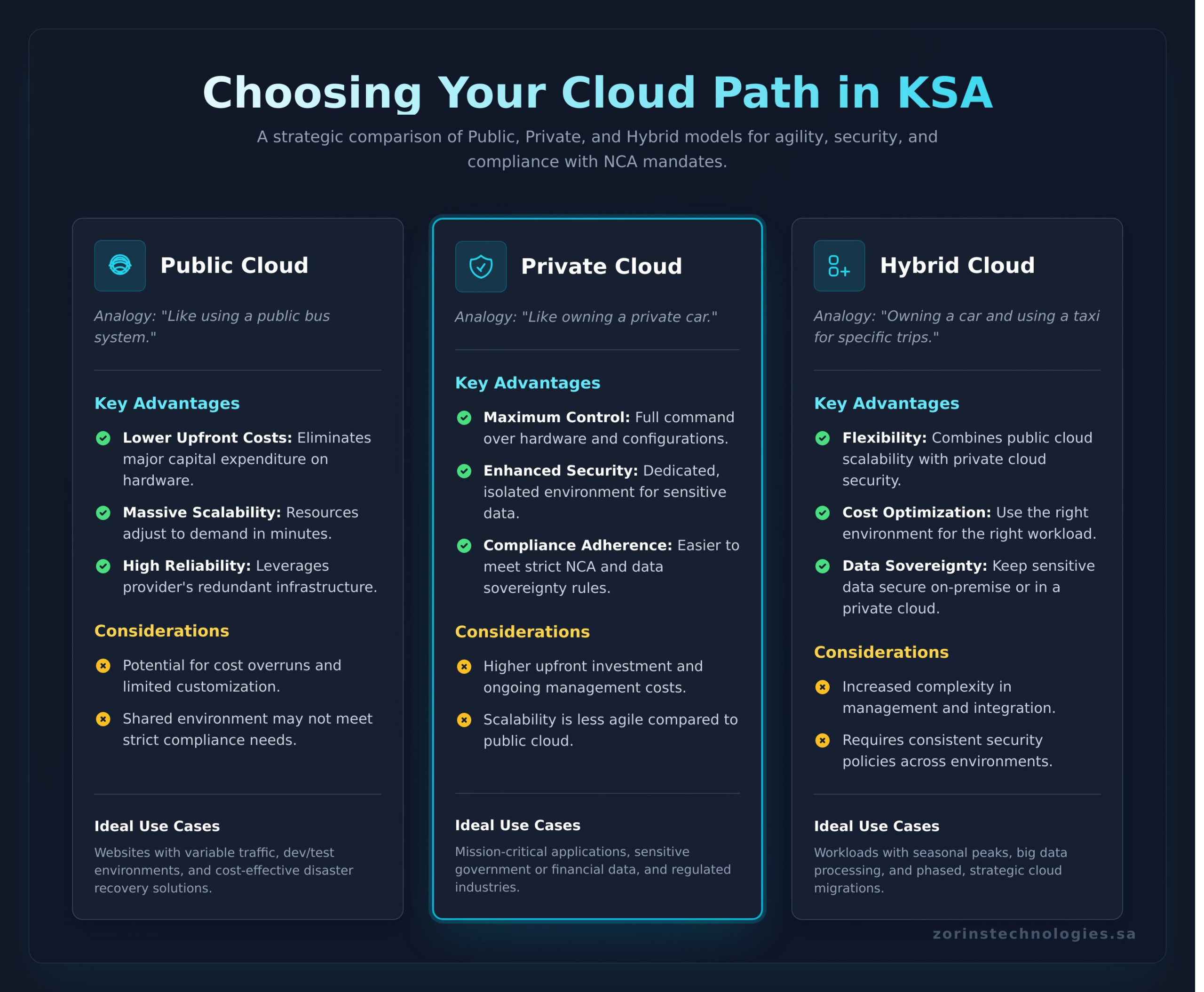
- Public Cloud: This is like using a public bus system. You share infrastructure with other organizations (tenants) and pay for what you use. It’s highly cost-effective, eliminating the need for large upfront capital expenditure in Saudi Riyal (SAR) and offering immense scalability on demand.
- Private Cloud: This is the equivalent of owning a private car. The infrastructure is dedicated exclusively to your organization, providing maximum control, security, and customization. This model requires a higher initial investment but offers unparalleled performance and privacy.
- Hybrid Cloud: This is like owning a car for daily commutes but using a taxi for specific trips, such as to the airport. It combines public and private clouds, allowing you to keep sensitive data on a private server while leveraging the public cloud’s scalability for less critical workloads.
Why is This Decision Critical for Businesses in Saudi Arabia?
For enterprises in the Kingdom, this choice is a strategic imperative. Aligning with the ambitious digital transformation goals of Saudi Vision 2030 requires a robust infrastructure. Furthermore, adhering to data sovereignty and compliance regulations set by the National Cybersecurity Authority (NCA) is non-negotiable. The right cloud strategy provides the agility and scalability needed to gain a decisive competitive edge in a rapidly evolving market.
Key Terms to Understand Before We Begin
To navigate this landscape, it’s essential to understand the service models:
- Infrastructure as a Service (IaaS): The foundational building blocks. You rent IT infrastructure—servers, storage, networking—from a cloud provider.
- Platform as a Service (PaaS): The next level up. This provides a platform for developers to build, test, and deploy applications without managing the underlying infrastructure.
- Software as a Service (SaaS): Ready-to-use software delivered over the internet, such as email, CRM, or ERP systems, typically on a subscription basis.
The Public Cloud Model: Scalability on Demand
The public cloud is a model where enterprise-grade computing services—such as servers, storage, and applications—are owned and operated by a third-party cloud service provider and delivered over the public internet. According to the foundational NIST Definition of Cloud Computing, this model operates on a multi-tenant architecture, meaning your business shares the same hardware infrastructure with other organizations, or ‘tenants.’ Global industry leaders like Amazon Web Services (AWS), Microsoft Azure, and Google Cloud Platform are the primary providers in this space.
For businesses in Saudi Arabia, the most compelling feature is often the pay-as-you-go pricing model. This structure eliminates the need for significant upfront capital expenditure on hardware and data centers, converting it into a predictable operational expense. Instead of investing millions of Saudi Riyals (SAR) in physical infrastructure, you pay only for the resources you consume, allowing for precise and flexible IT budgeting.
Key Advantages of Public Cloud
Adopting a public cloud strategy delivers several powerful business benefits:
- Lower Upfront Costs: Eradicate the need to purchase and manage on-premise hardware. This allows capital to be reallocated to core business initiatives for sustainable growth.
- Massive Scalability: Seamlessly scale your computing resources up or down in minutes to meet fluctuating demand, ensuring optimal performance during peak traffic periods like seasonal sales events.
- High Reliability: Leverage the provider’s vast, redundant network of data centers, which guarantees robust uptime and business continuity far exceeding what most individual businesses can achieve.
Potential Disadvantages and Considerations
While powerful, the public cloud requires strategic management:
- Security & Compliance: The shared environment may not be suitable for all workloads, especially those subject to stringent KSA regulatory requirements from entities like the Communications and Information Technology Commission (CITC).
- Cost Management: Without diligent monitoring and governance, the pay-as-you-go model can lead to unexpected and escalating monthly bills in SAR.
- Less Control: Businesses have limited control and customization options over the underlying hardware and infrastructure, as it is managed entirely by the provider.
Ideal Use Cases for Public Cloud
The public cloud excels in specific scenarios, including:
- Websites and applications with unpredictable or fluctuating traffic.
- Development and testing environments that need to be spun up and down quickly.
- Cost-effective disaster recovery and data backup solutions for enterprise resilience.
The Private Cloud Model: Control and Security
For organizations in Saudi Arabia where data security and regulatory compliance are paramount, the private cloud offers an impregnable, dedicated environment. A private cloud is a single-tenant infrastructure, meaning all its computing resources are used exclusively by one business. This model provides an isolated and secure foundation for your enterprise operations. It can be deployed in two primary ways: on-premise, where your organization owns and manages the hardware in its own data center, or as a hosted private cloud, where a third-party provider, like Zorins Technologies, hosts and manages dedicated infrastructure for you.
This model typically involves a higher initial capital expenditure (CapEx), with significant upfront investments in hardware from leading partners like HPE and Cisco, potentially costing hundreds of thousands of Saudi Riyals. However, it can lead to a more predictable and potentially lower total cost of ownership (TCO) over time by reducing variable operating expenses (OpEx).
Key Advantages of Private Cloud
The primary driver for adopting a private cloud is the unparalleled level of control and security it provides for mission-critical enterprise workloads.
- Enhanced Security: Your data and applications exist in a completely isolated environment, significantly reducing the risk of unauthorized access and external threats.
- Greater Control: Gain complete authority over your hardware, software, and networking configurations, allowing for deep customization to meet precise performance and security requirements.
- Compliance and Data Sovereignty: A private cloud makes it simpler to adhere to strict data residency and protection regulations within the Kingdom, such as those mandated by the National Cybersecurity Authority (NCA).
Potential Disadvantages and Considerations
While powerful, the private cloud model demands significant resources and strategic planning.
- Higher Cost: The upfront investment in purchasing and deploying enterprise-grade servers, storage, and networking equipment is substantial.
- Limited Scalability: Scaling capacity requires a lengthy process of procuring, provisioning, and integrating new hardware. This limitation is a key reason many KSA businesses now favor a hybrid cloud approach to combine private security with public cloud flexibility.
- Management Overhead: Operating a private cloud requires a dedicated, highly skilled in-house IT team or a trusted managed services partner to handle maintenance, updates, and security monitoring.
Ideal Use Cases for Private Cloud
The private cloud model is the optimal choice for organizations with non-negotiable security and compliance needs. This includes government agencies, financial institutions handling sensitive transaction data, healthcare providers protecting patient records, and any enterprise with mission-critical legacy applications that demand a stable, high-performance, and completely controlled infrastructure.
The Hybrid Cloud Model: The Best of Both Worlds
For many enterprises in Saudi Arabia, the optimal cloud strategy is not a choice between public and private, but a strategic integration of both. The hybrid cloud model is a cutting-edge IT architecture that combines a private cloud with one or more public cloud services, allowing workloads, applications, and data to be shared between them. This approach provides businesses with greater flexibility and more data deployment options.
A powerful example of this synergy is ‘cloud bursting’. An application can run day-to-day within the security of a private cloud. However, during periods of peak demand, such as a major e-commerce sale or a seasonal traffic surge, the workload can seamlessly ‘burst’ into the public cloud to access additional computing resources. This ensures optimal performance without the need to over-invest in on-premise infrastructure that sits idle most of the time.
Key Advantages of Hybrid Cloud
This model delivers a powerful combination of control and scalability, making it an increasingly popular choice for mission-critical operations.
- Flexibility and Agility: Place workloads in the most appropriate and efficient environment. Use the public cloud for dynamic, scalable applications while keeping sensitive, regulated data within your private infrastructure.
- Strategic Cost Optimization: Pay for extra public cloud compute power only when needed, avoiding significant capital expenditure. This allows for a more predictable IT budget, converting CapEx to OpEx for variable workloads.
- Enhanced Security and Compliance: Keep critical business data and applications on-premise in a private cloud to meet stringent KSA data residency and compliance regulations, while leveraging the public cloud for less sensitive tasks.
Potential Disadvantages and Considerations
While powerful, a hybrid environment introduces layers of complexity that require expert management.
- Management Complexity: Orchestrating and securing two distinct cloud environments requires a specialized skillset and advanced management tools to maintain visibility and control.
- Integration Challenges: Ensuring seamless and secure communication between the private and public clouds is critical. This demands robust integration planning and execution from a trusted IT partner.
- Network Dependency: A high-speed, low-latency, and secure network connection between your on-premise data center and the public cloud is non-negotiable for reliable performance.
Ideal Use Cases for Hybrid Cloud
- Businesses in the KSA retail sector with significant seasonal traffic spikes (e.g., Ramadan, National Day sales).
- Financial and healthcare organizations that must keep sensitive customer data on-premise but want to leverage public cloud tools for development and analytics.
- Large enterprises undertaking a phased, strategic migration to the cloud, moving workloads incrementally without disrupting business continuity.
Comparison Matrix: Which Cloud Model is Right for Your KSA Business?
Selecting the right cloud deployment model is a critical strategic decision for any enterprise in the Kingdom. The optimal choice is not universal; it depends entirely on your organization’s specific operational, security, and financial requirements. This comparison provides a clear framework to guide Saudi business leaders toward the most effective and cost-efficient cloud strategy.
Feature-by-Feature Comparison Table
| Criterion | Public Cloud | Private Cloud | Hybrid Cloud |
|---|---|---|---|
| Cost |
|
|
|
| Security |
|
|
|
| Control |
|
|
|
| Scalability |
|
|
|
| Management |
|
|
|
A Decision Framework for Saudi Enterprises
To identify the optimal cloud architecture, your leadership team should address these fundamental questions. The most critical factor is aligning your technology strategy with your core business objectives.
- Security & Compliance: How sensitive is your data? Are you processing mission-critical information that must comply with strict KSA regulations from bodies like the National Cybersecurity Authority (NCA)? A private or hybrid model is often necessary for stringent compliance.
- Cost & Budget: Is your financial goal to shift from capital expenditure (CapEx) to a more flexible operational expenditure (OpEx) model? Public cloud excels at this, while private cloud represents a significant upfront investment in SAR.
- Scalability & Performance: Do your workloads experience sudden, unpredictable traffic spikes, or is demand relatively stable? Public and hybrid clouds offer superior elasticity for variable demand.
- Management & Expertise: Does your organization possess the in-house IT skills and resources to build, manage, and secure your own cloud infrastructure? If not, the managed nature of public cloud offers a distinct advantage.
Ultimately, the right cloud model empowers your business to achieve its goals for sustainable growth and innovation. For a strategic consultation to determine the optimal cloud strategy for your enterprise, contact our expert team today.
Your Strategic Cloud Partner in Saudi Arabia: Zorins Technologies
Understanding the differences between public, private, and hybrid cloud models is the first step. The next, more critical step is implementing the right strategy for your KSA business. This is where a trusted technology partner becomes invaluable. At Zorins Technologies, we translate cloud theory into tangible business outcomes, ensuring your infrastructure is secure, scalable, and perfectly aligned with your objectives.
Our expertise spans all three cloud models, allowing us to provide unbiased, expert guidance. We leverage strategic partnerships with global industry leaders like Cisco, HPE, Dell, and Fortinet to architect and deliver robust, high-performance private and hybrid cloud solutions. This powerful combination of in-house knowledge and best-in-class technology ensures your IT foundation is built for sustainable growth and resilience.
Designing Your Ideal Cloud Infrastructure
Our process begins with a thorough assessment of your business goals, operational workflows, and existing IT environment. We design custom-engineered private and hybrid cloud solutions using premier hardware from partners like HPE and Dell for maximum control and performance. For workloads suited to the public cloud, we help you leverage leading providers to achieve optimal cost-efficiency and scalability, ensuring a truly integrated and effective infrastructure.
Ensuring Security and Compliance in the Cloud
In the Kingdom of Saudi Arabia, security and compliance are paramount. Our deep cybersecurity expertise ensures your cloud environment is protected against advanced threats. A key part of our service is helping you navigate the complexities of National Cybersecurity Authority (NCA) regulations and local data residency requirements. We deploy advanced security solutions from partners like Fortinet to create an impregnable defense for your critical data and applications.
Managed Services for a Seamless Experience
The true power of a hybrid cloud is unlocked when it is managed seamlessly. Let our expert team handle the complexity of monitoring, managing, and optimizing your hybrid environment 24/7. By entrusting your IT infrastructure to Zorins Technologies, you free up your internal resources to focus on core business innovation and growth. We handle the technology, so you can handle your business. Request a strategic cloud consultation with our experts today.
Your Strategic Cloud Partner in Saudi Arabia
Navigating the choice between public, private, and hybrid cloud models is a critical decision for any KSA business aiming for digital transformation. The key takeaway is that there is no single best answer; the optimal solution depends entirely on your specific needs for scalability, security, and cost-efficiency. The most crucial first step is to conduct a thorough assessment of your operational requirements against the backdrop of Saudi Arabia’s unique regulatory and market landscape.
This is where a seasoned expert makes all the difference. At Zorins Technologies, we leverage our deep expertise in cybersecurity and IT infrastructure to guide you. As a premier partner for leading global brands like Cisco, HPE, and Fortinet, we have a proven track record of designing and managing complex enterprise IT solutions that drive sustainable growth and ensure business continuity for organizations across the Kingdom.
Don’t leave your cloud strategy to chance. Empower your enterprise with a robust, secure, and future-proof cloud foundation. Contact our professionals for a strategic cloud consultation today.
Frequently Asked Questions
What is a multi-cloud strategy and how is it different from hybrid cloud?
A multi-cloud strategy involves using services from multiple public cloud providers (e.g., AWS, Azure, Google Cloud) to leverage the unique strengths of each platform for different workloads. This approach avoids vendor lock-in. A hybrid cloud, in contrast, is an integrated architecture that combines a private cloud or on-premises infrastructure with at least one public cloud, allowing data and applications to be shared between them for optimal performance and security.
How does data sovereignty in Saudi Arabia affect my choice of cloud provider?
Data sovereignty is a critical factor for businesses in the Kingdom. Regulations like the Personal Data Protection Law (PDPL), enforced by authorities such as the Saudi Data & AI Authority (SDAIA), mandate that certain sensitive data must reside within Saudi Arabia. Therefore, your choice of cloud provider must include those with established, in-country data centers to ensure full legal compliance, avoid penalties, and reduce data latency for your local customer base.
Can I move from one cloud model to another as my business grows?
Absolutely. Cloud strategies must be dynamic to support sustainable growth. A startup might begin with a cost-effective public cloud, later integrating a private cloud for sensitive workloads to create a hybrid environment. As operations expand, adopting a multi-cloud strategy for resilience and specialized functions is a common and logical evolution. The key is that your cloud architecture is designed for this future flexibility from the outset.
What are the first steps in planning a cloud migration?
A successful cloud migration begins with a comprehensive assessment of your current IT infrastructure, applications, and data dependencies. The next step is to define clear business objectives and key performance indicators. Based on this, you can develop a robust strategy that includes selecting the appropriate cloud model (public, private, or hybrid), choosing a provider, and creating a detailed roadmap that outlines timelines, security protocols, and a full cost analysis in SAR.
How do you ensure the security of data in a public cloud environment?
Security in a public cloud operates on a shared responsibility model. While the provider secures the core infrastructure, your enterprise is responsible for protecting your data, applications, and access controls. We ensure impregnable defense by implementing advanced encryption, multi-factor authentication, and robust Identity and Access Management (IAM) policies. Continuous monitoring with enterprise-grade cybersecurity solutions from industry leaders like Cisco and Fortinet is essential for threat detection and response.
Is it possible to build a private cloud that is as scalable as a public cloud?
Yes, a modern private cloud can achieve impressive scalability. By leveraging hyper-converged infrastructure (HCI) from partners like HPE and advanced automation and orchestration tools, an enterprise can build an on-premises cloud that offers on-demand resource provisioning similar to a public cloud. While this requires a significant initial capital investment, it provides unparalleled control, dedicated performance, and enhanced security for mission-critical workloads.
STAY IN THE LOOP
Subscribe to our free newsletter.
Leave A Comment

Navigating the path to a successful career in cybersecurity within Saudi Arabia can feel overwhelming. With a rapidly evolving digital landscape...

In today's hyper-connected Saudi Arabian economy, the term الأمن السيبراني (cybersecurity) is more than an IT department issue; it is a...

As Saudi Arabia's digital transformation accelerates towards Vision 2030, the landscape for cyber security in Saudi Arabia has become increasingly...